Café Coffee Day's tagline is "A Lot Can Happen Over Coffee." They weren't kidding. Over two evenings in July 2026, working from nothing but curiosity and a copy of their Android app, I found a chain of vulnerabilities that, stitched together, handed me the phone numbers, emails, invoices and eventually the accounts of what looked like every CCD customer in the country. All of it starting from a file anyone can download off the Play Store.
This was independent research, done in my own free time, the same way I've poked at other systems before. Nobody hired me and nobody asked me to look. Fittingly, a good chunk of it happened while I was sitting inside a Café Coffee Day, the outlet on the IIT Kanpur campus, nursing a cappuccino and prodding the very app I'd just used to order it. I was just curious how a coffee app that quietly holds millions of people's data actually works under the hood, and the answer turned out to be "not very carefully."
What makes this one different from some of my earlier writeups, like the critical vulnerabilities I found in CBSE's On-Screen Marking portal, is that it has a genuinely happy ending. Where that disclosure turned into months of silence and public denial, this one didn't. I reported everything to CERT-In, they forwarded it to the company, and the whole chain was fully patched within ten days. I then went back and re-verified every fix myself before writing a word of this. In this line of work that kind of turnaround is rare enough to be worth calling out, so: credit where it's due.
One thing I want to be clear about up front. This was strictly look-don't-touch. Nothing was modified or deleted, no customer data was ever downloaded in bulk, and in every case I stopped the moment a flaw was proven rather than pushing further. All of the account-takeover and OTP testing was done against my own number and my own account. Noticing that a door has been left wide open is not the same thing as walking through it.
Timeline
| Date | Event |
|---|---|
| 07 Jul 2026 | Pulled apart the CCD Android app (com.ccd.app.global v1.0.12) out of pure curiosity. |
| 08 Jul 2026 | Realised how bad it was and reported the full chain to CERT-In. Registered under Ref: CERTIn-51351626. |
| 18 Jul 2026 | CERT-In relayed that the company had confirmed every vulnerability was fixed. |
| 18 Jul 2026 | Independently re-tested each finding against production — all confirmed remediated. Published this writeup. |
What is CCD?
Café Coffee Day is one of India's largest coffee-shop chains, with hundreds of outlets across the country. Like most retail brands it has a mobile app: you use it to order ahead, pay, collect loyalty points, and store your profile. The app is a native Kotlin (Jetpack Compose) application, and its backend lives on *.reciproci.com, a platform built by the vendor TechTree IT.
Anything that stores millions of customers' phone numbers, order histories and payment details is worth looking at carefully. So I pulled the APK apart.
Getting In: Reading the App
The app ships its logic in compiled Kotlin/Java, so step one was to rip the APK open with JADX and start reading. This is the unglamorous part nobody puts in the movies: thousands of files of obfuscated, single-letter-named classes, and you just… read, until the shape of the thing appears. Two things jumped out almost immediately.
The first was that the app "encrypts" every request and response body. Every API call goes out wrapped like this:
{ "requestData": "aGVsbG8gdGhlcmUgZnJpZW5k..." }
The second was how it encrypts them. The entire scheme hangs on a single AES key, and that key is baked directly into the app.
Static analysis only gets you so far, though. To actually watch the app talk to its backend I set up a full dynamic rig: a rooted Android emulator, Frida for runtime instrumentation, and a set of hooks to defeat the app's certificate pinning and dump traffic in the clear. Frida lets you reach into a running process and rewrite it live, so I could hook the app's own crypto routines and print every request before it got encrypted and every response after it got decrypted. From that point on, the app's "encryption" wasn't slowing anything down; I was reading its mail in plaintext as it was written. (This rig came back to save me later, too, when the fixed build tried to make my life harder.)
The Client-Side Crypto Was Theatre
Buried in a utility class (AppUtil.k()) was the app's master key, lightly obfuscated by an array that just swaps adjacent byte pairs, which is trivially reversible. Undo the swap and you get a hardcoded AES-128-CBC key that is identical across every install. To make matters worse, the same value is reused as the IV.
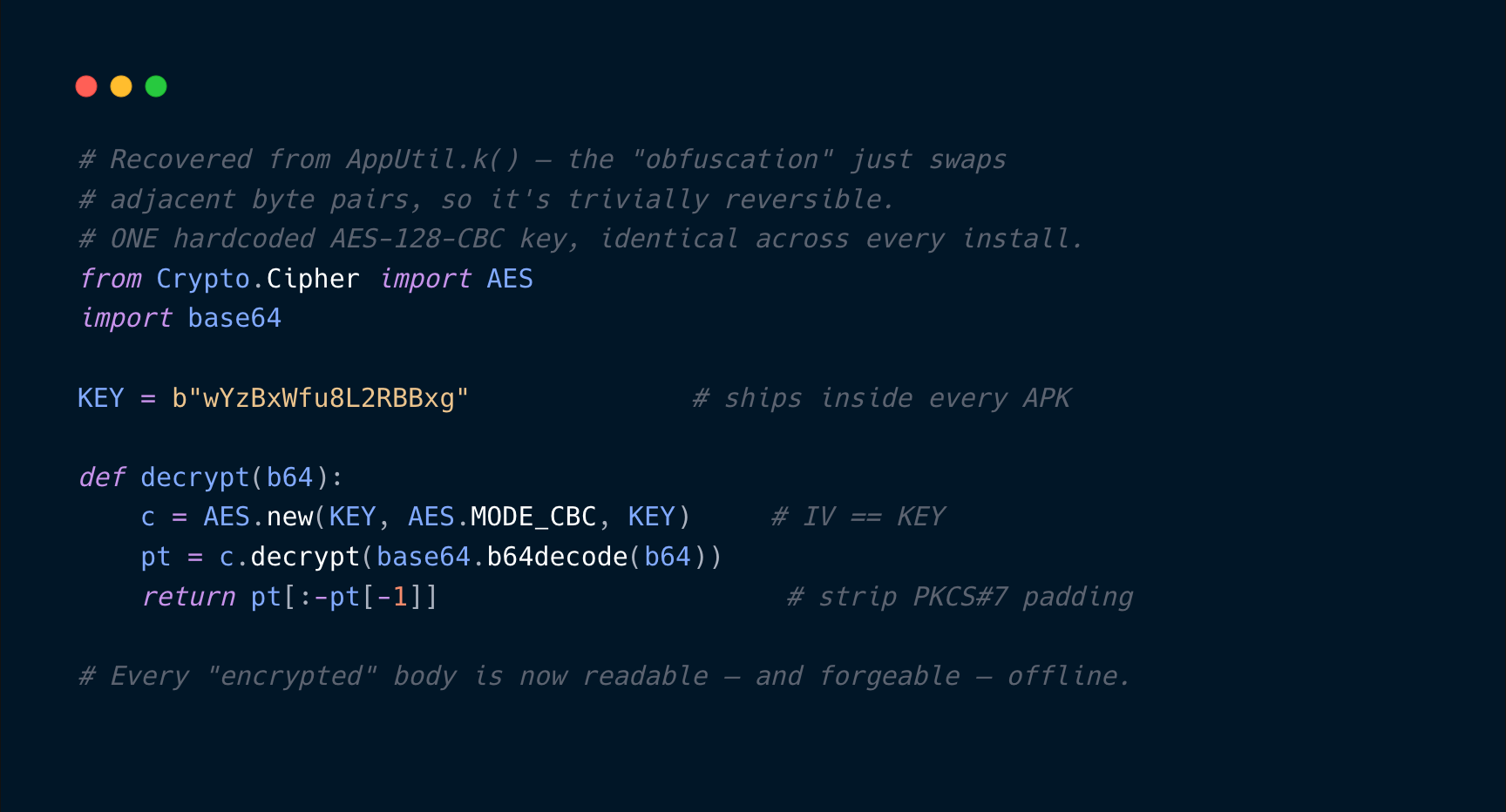
That single key protects all API traffic, the local token store, and even the phone-number "encryption" used during login. Because it ships inside the app, anyone can extract it, decrypt captured traffic, and forge or tamper with any encrypted payload offline. A secret that every user already has on their phone isn't a secret.
On its own, that's a "defense-in-depth is broken" finding. The real problem was that this encryption was the only thing standing in front of the API, and several endpoints didn't even require it. Many accepted plain, unencrypted JSON bodies directly. The wrapper wasn't a security control; it was a speed bump that kept casual observers from noticing what the API actually did.
Finding #1: A Wide-Open S3 Bucket
I hadn't even started on the API properly when the storage layer handed me the single biggest finding of the night, no exploitation required.
The app pulls its images out of an Amazon S3 bucket, ccd-multimedia.s3.ap-south-1.amazonaws.com. Standard stuff, so almost as a reflex I pointed a plain curl at it to see if it would list. It shouldn't have. It did. The bucket was configured with a public AllUsers: READ ACL, which means anyone on the internet could list and download its entire contents with no credentials, no signature, nothing at all. No login screen, no token, no clever trick. Just a URL.
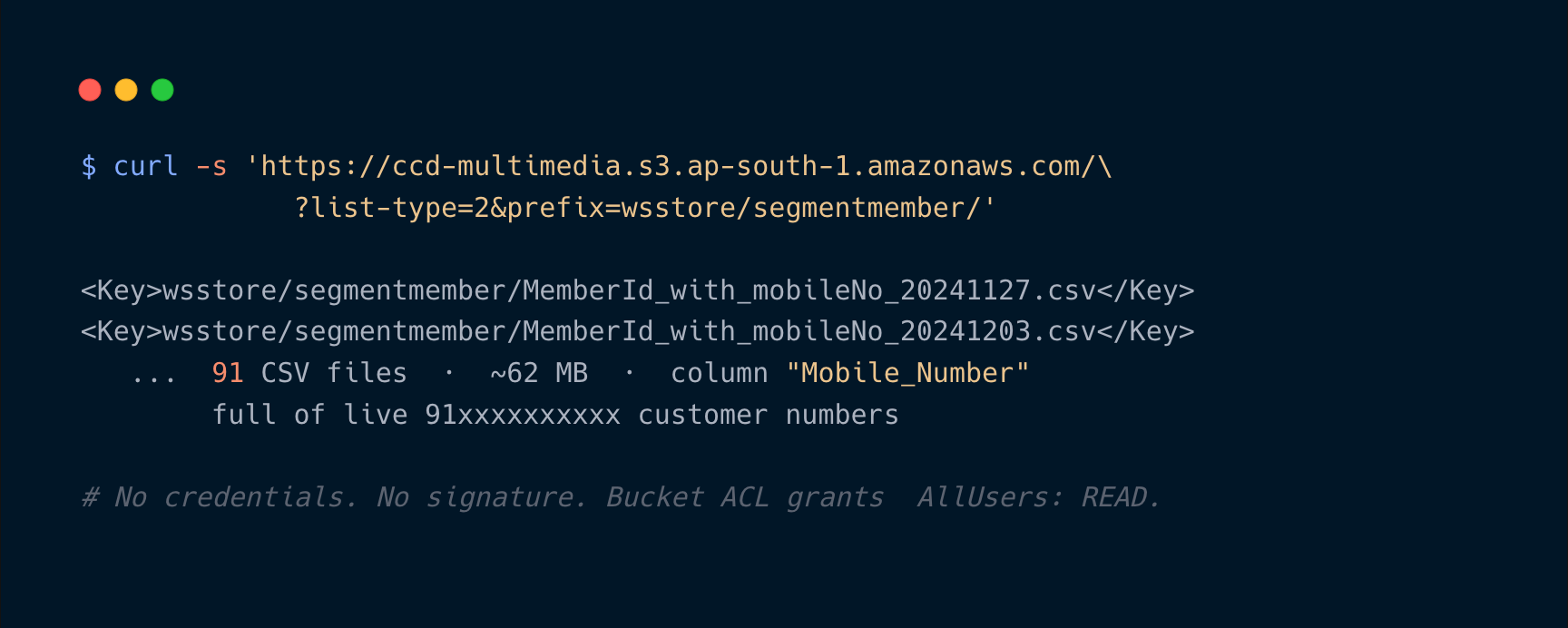
And it was not storing coffee-cup photos. Paginating through the listing turned up exactly the kind of thing that makes your stomach drop a little:
wsstore/segmentmember/— 91 CSV exports (~62 MB) with names likeMemberId_with_mobileNo_*.csv. These were chunks of the marketing database, each containing aMobile_Numbercolumn full of live91xxxxxxxxxxcustomer numbers.wsstore/profile/— over 15,000 customer profile photos (~4.7 GB, and still truncating).wsstore/txnInvoices/— more than 3,000 customer tax-invoice PDFs (name, itemised order, amounts, GST).wsstore/feedbackReport/andwsstore/segmentation/— feedback and customer-segmentation exports.
To make sense of what was in there without blindly downloading anything, I threw together a small read-only browser that just lists the bucket and previews objects in place. It reported over a million files across twenty folders, which is roughly the moment "misconfiguration" turns into "the whole customer estate":
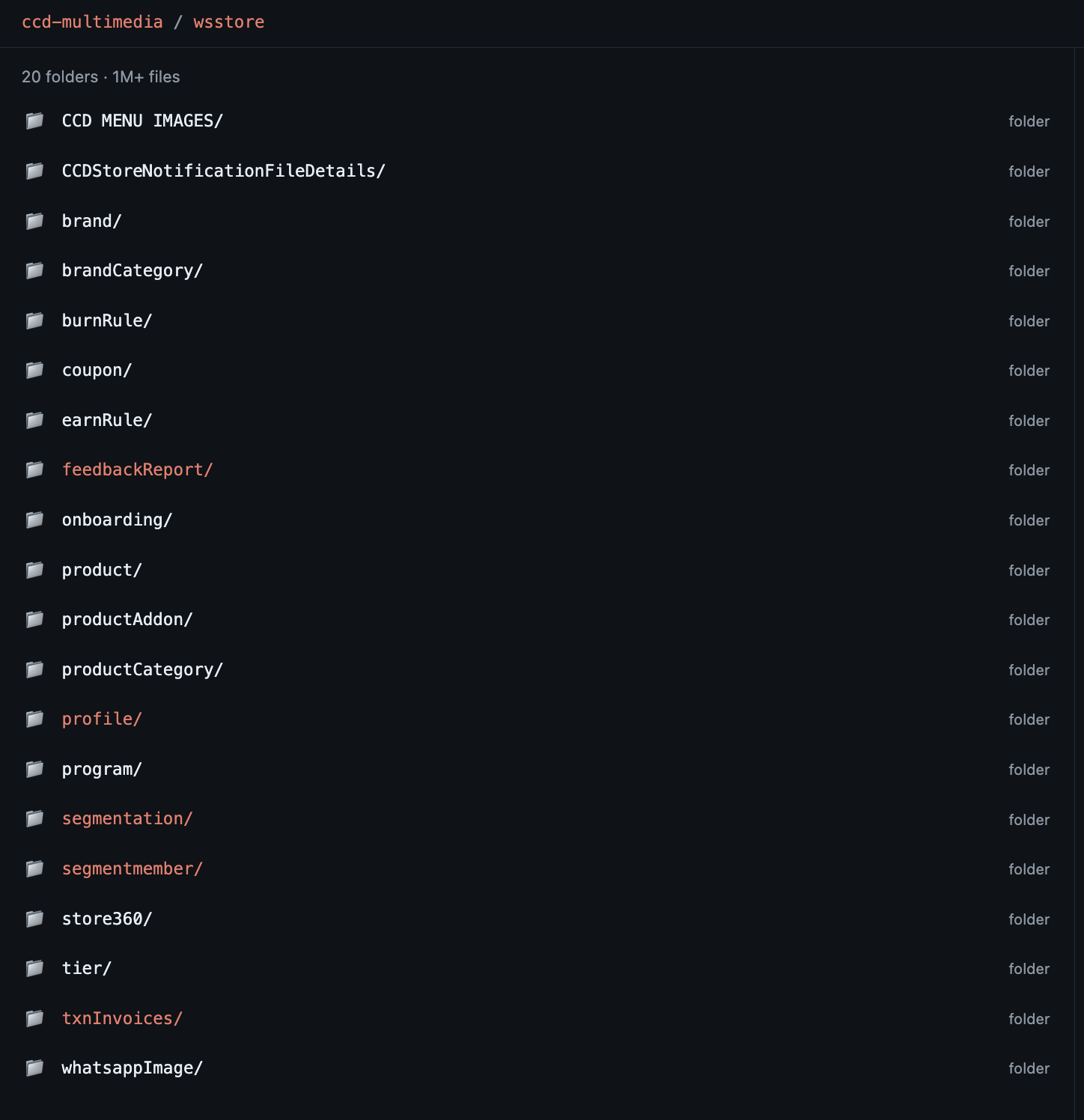
The bucket's ACL was itself world-readable, so I could literally read the misconfiguration that caused all this back off the server: AllUsers: READ, in black and white. To its small credit, the exposure was read-only. An anonymous PUT and DELETE both came back 403, so nobody could quietly swap someone's invoice for a malicious PDF or wipe the bucket. All you could do was download every last byte of it. Which, when the "it" is the phone numbers, photos and invoices of what appears to be the entire customer base, is more than enough. This was a full customer-data breach that didn't even need the app installed, and I hadn't yet touched a single API endpoint.
Finding #2: Downloading Anyone's Invoice, No Login Required
Next, the API. One of the unsec/ (unauthenticated) endpoints was invoice/download:
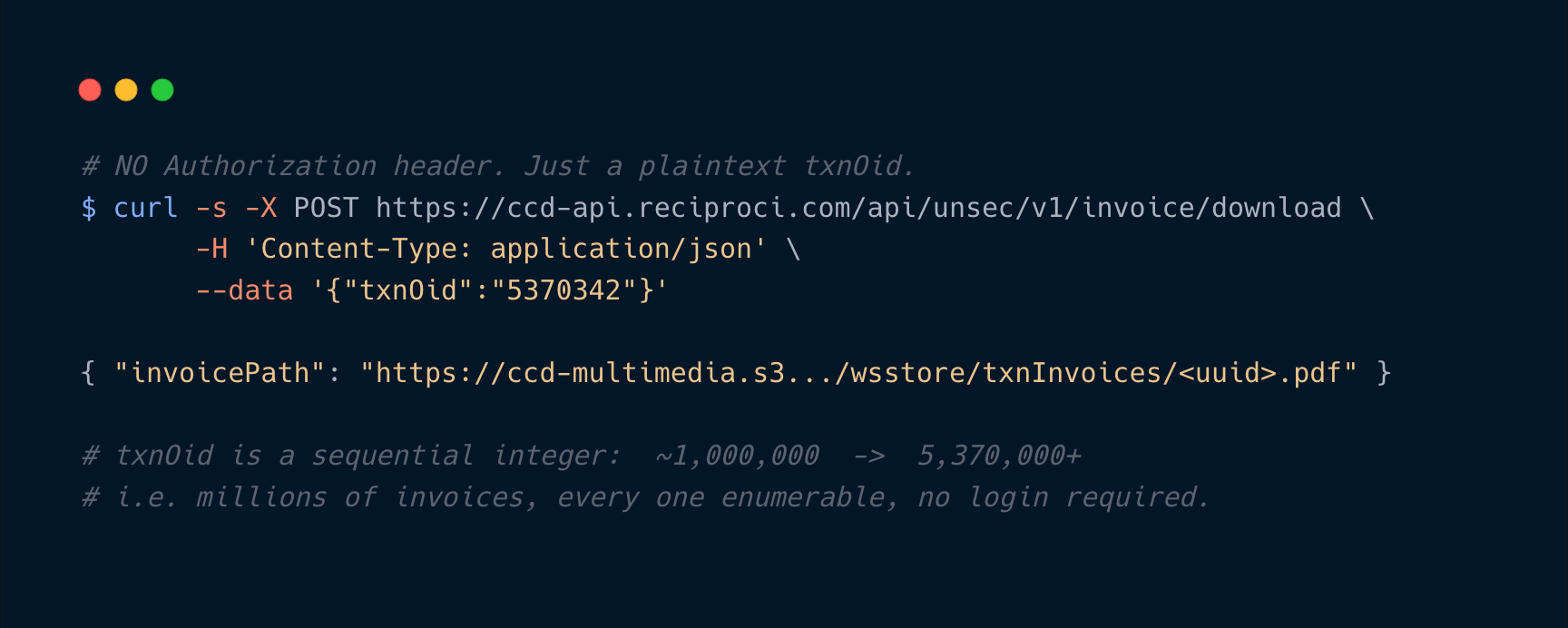
With no Authorization header at all, you send a plaintext {"txnOid": <id>} and get back a public S3 URL to that customer's tax-invoice PDF. The txnOid is a simple sequential integer; the values I saw spanned from around 1,000,000 up past 5,370,000, i.e. millions of orders, each one a valid, enumerable invoice. A sibling endpoint, invoice/view, returned the same data as structured JSON, which is even easier to scrape.
Opening one of those txnInvoices PDFs straight from the bucket gives you a complete tax invoice — store, date, itemised order, taxes, amounts, and the customer's name (redacted here; the numbers were left intact only to show the flaw):
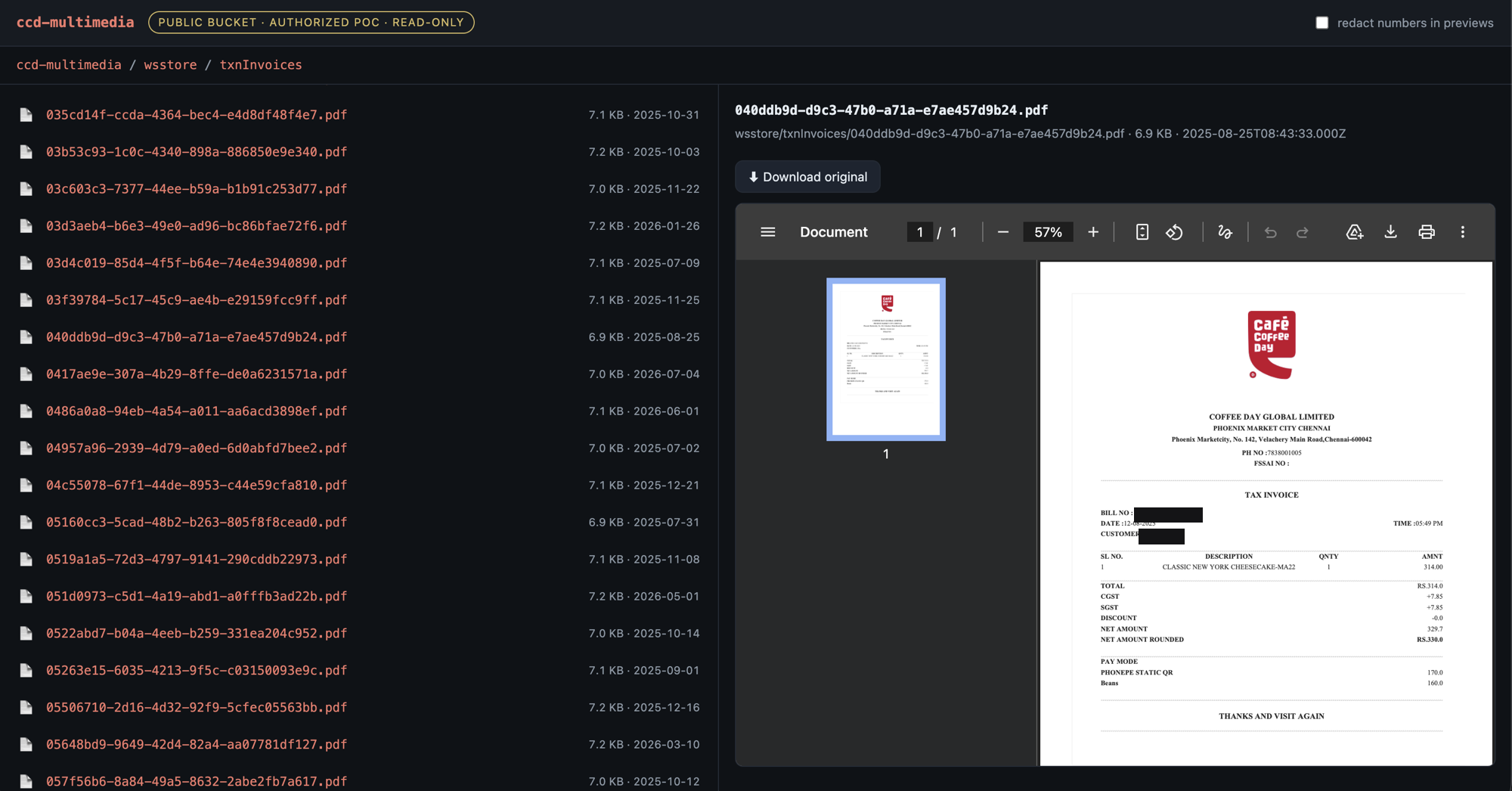
So already, before ever creating an account, an attacker could walk that sequential txnOid and harvest every CCD customer's name, order details and amounts. That alone is a serious breach, but an invoice doesn't carry a phone number, and a phone number was what I needed to turn this into something worse. The next endpoint gave me exactly that.
Finding #3: The Endpoint That Handed Out Phone Numbers
This is the one that took an ugly data-exposure story and turned it into a full account-takeover story.
Deeper in the API sat POST /api/ns/order/v6/get, which returns the full details of an order. This one actually asks for a Bearer token, so at first glance it looks like the grown-up in the room. The catch is that "a token" is all it wants. It checks that you're logged in as somebody; it never checks that the order you're asking about is yours.
That's a textbook Broken Object Level Authorization flaw (a BOLA, cousin of the classic IDOR), and there's a simple way to test for it: log in as yourself, then ask for something that isn't yours and see if the server says no. So I made a throwaway account, looked up my own order id, and then just… subtracted one.
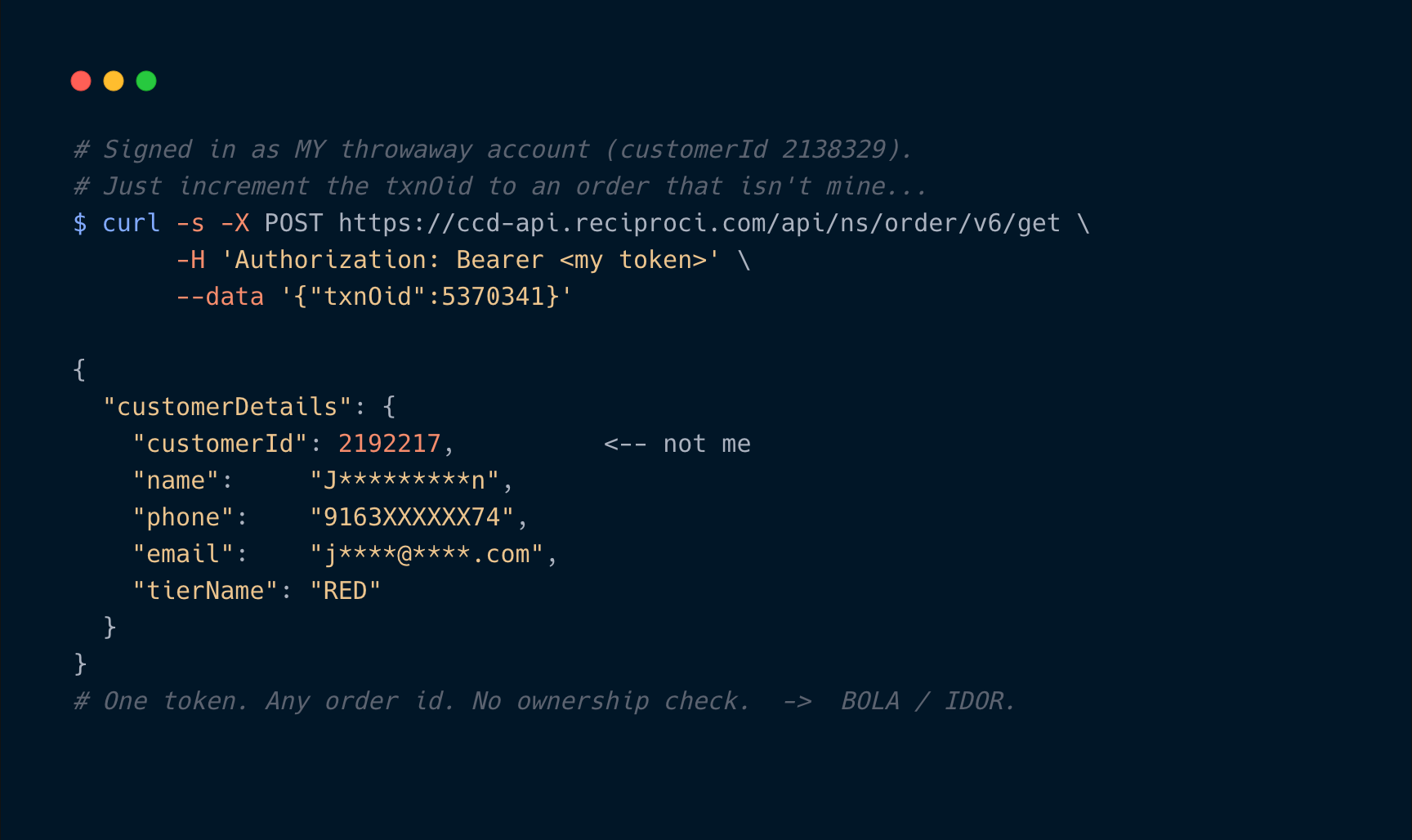
My own id gave me my own order, as it should. The very next id down gave me a stranger's order, and sitting inside it was a customerDetails block with their name, phone number, email address and loyalty tier printed in plaintext, and for delivery orders, the recipient's full street address and mobile number too. Every id I tried resolved to a real person who was not me, every one of them read with my one throwaway token. It's a genuinely strange feeling to type a number, hit enter, and have a stranger's phone number scroll up your terminal.
Now recall that txnOid is the exact same sequential number that Finding #2 hands out to anyone, no login required. That's the moment the individual bugs stop being bugs and become a machine: enumerate the order space unauthenticated, pipe each id into order/v6/get behind one disposable account, and you can walk the entire customer base pulling names, phones and emails on a loop. I stopped at a tiny handful of ids, just enough to be certain it was real. The point of a proof of concept is to prove it, then put the gun down.
Finding #4: Account Takeover via Unthrottled OTP Brute-Force
By now I had a way to get anyone's phone number. Which raises the obvious next question: so what? A phone number on its own is just a phone number. This finding is what connected it to someone's actual account.
CCD logs you in with an OTP, driven by two unauthenticated endpoints: customer/v4/verification texts a code to a number and hands back a referenceId, and otp/v5/verify checks a code against that reference. Two facts turned that into a brute-force target. First, the OTP is only 5 digits — a hundred thousand possible codes, which sounds like a lot until you remember computers count fast. Second, and this is the fatal one, otp/v5/verify had no rate limiting, no lockout, and no CAPTCHA of any kind.
There's really only one way to confirm something like that, so I pointed it at my own number and my own reference and fired 60 deliberately wrong codes at it, back to back, to see when it would flinch:
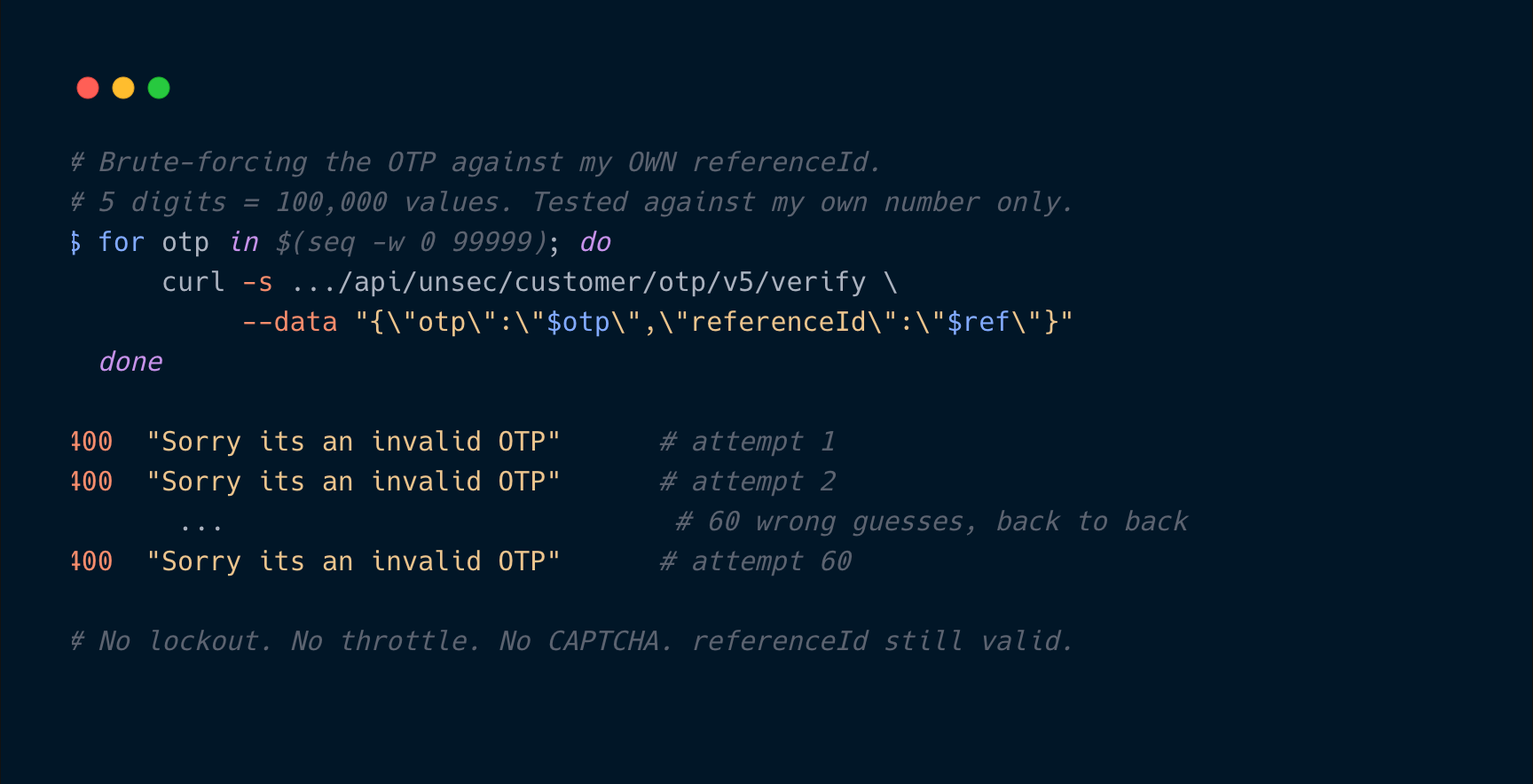
It never flinched. All sixty came back 400 "Sorry its an invalid OTP", and the referenceId was still happily valid at the end of it. No slowdown, no lockout, no "too many attempts, try later." A correct guess, meanwhile, returns a complete session: accessToken, refreshToken, customer_id. So the whole login reduces to a race through at most 100,000 codes, unthrottled and trivially run in parallel, against a door that never locks. Know the phone number, and you can take the account, without the victim's phone ever buzzing in a way they'd notice.
Stitching It Together
Individually these are serious. Chained, they're an unauthenticated, victim-agnostic mass account-takeover primitive:
- Finding #2 gives you unauthenticated, sequential enumeration of every order ID.
- Finding #3 turns each order ID into a real customer's phone number, with one throwaway token.
- Finding #4 turns any phone number into an unthrottled path toward that account.
To be precise about that last step: Finding #4 doesn't magically hand you the account. It's a brute-force, so you still have to grind through the OTP space to actually get in. But that's exactly the point of a rate limit, and there wasn't one. A 5-digit code with no lockout and no throttle is a finite, parallelisable guessing game that the server will patiently let you keep playing until you win. It's not a guaranteed instant takeover; it's an open door with a numeric lock and unlimited attempts, which in practice is almost as bad.
So chain the three together and the shape is unmistakable: start from nothing, pick an ID range, and what comes out the other end is a working route into stranger after stranger's account, with no prior knowledge of any target required. That's the whole thing, and it's why I stopped poking and wrote it up to CERT-In the same day I finished mapping it.
What Was Actually Solid
It's only fair to note where the backend held up, because it did in a few important places. I tested the payment and cart flow end-to-end by driving a real ₹90 order and replaying it with a tampered billAmount of ₹1; the server ignored the client amount, recomputed the price from the catalogue, and generated its own payment hash. Cart pricing is server-authoritative, so "pay ₹1 for a ₹90 order" doesn't work. The JWT was also robust (alg:none, junk signatures, and tampered payloads were all rejected), the mobile-number change was blocked server-side, and the delivery-address endpoints correctly enforced ownership. The problems were concentrated in the read paths and the OTP flow, not everywhere.
Responsible Disclosure
I reported the full chain to CERT-In on 8 July 2026, and it was registered under Ref: CERTIn-51351626:
Dear Sir/Madam,
Thank you for reporting this incident to CERT-In. We have registered your complaint/incident under Ref: CERTIn-51351626.
They asked for a detailed, timestamped, step-by-step PoC for each finding, which I put together as a single runbook that prints both a local clock and the server's own Date: header at every step, so the evidence is self-authenticating. That went back to them along with screen recordings.
Then, on 18 July, the reply I wish every disclosure ended with:
With reference to trailing mail, the concerned organization has confirmed that the reported vulnerabilities are fixed. You are requested to verify at your end and confirm.
Verifying the Fix
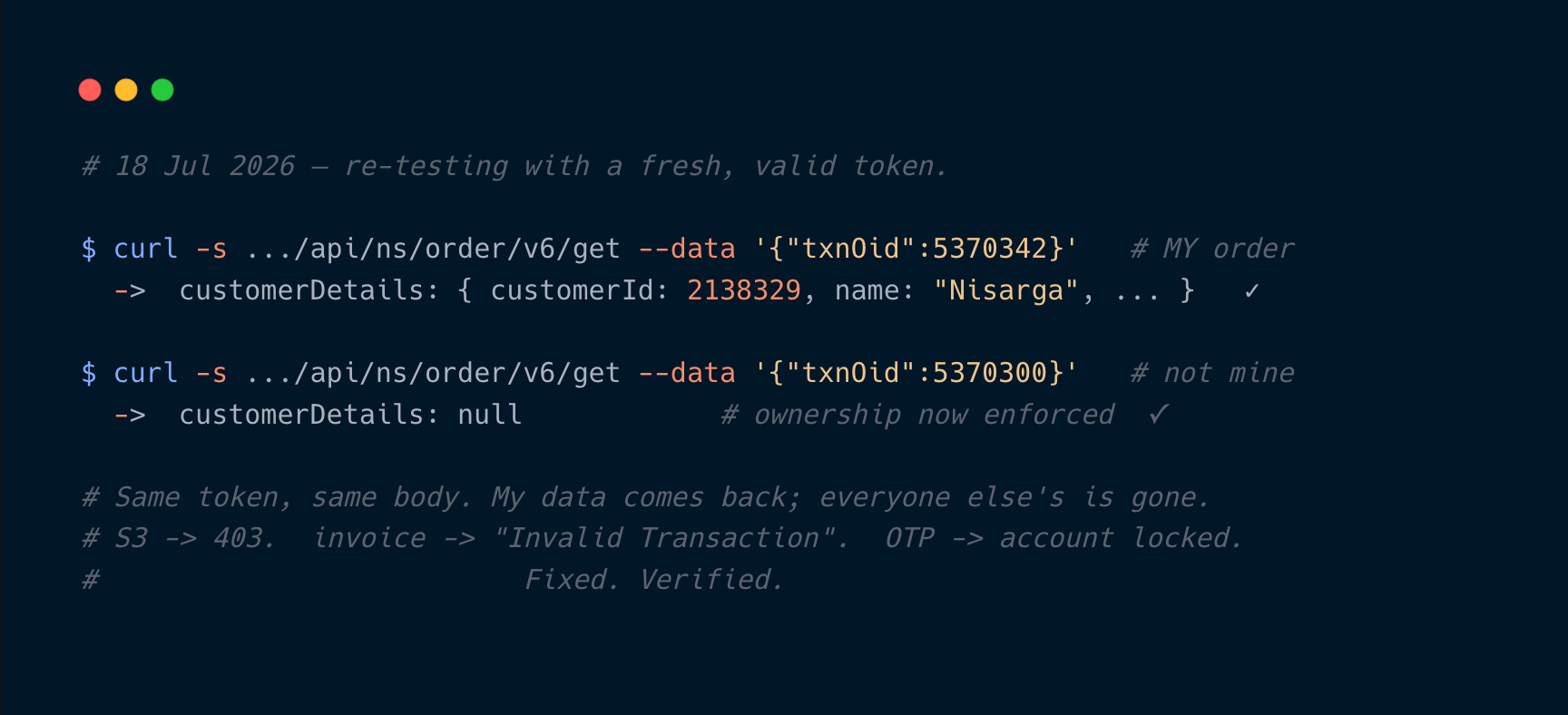
I don't take "it's fixed" on faith, so I re-tested everything against production the same day. The unauthenticated findings were easy to check with a few curls. The order BOLA was trickier, because it needs a valid login token, and by now the company had shipped a hardened build (v1.0.13) that made grabbing one genuinely annoying.
This is where my old dynamic rig earned its keep. The new build had stopped stashing the token in plain reach and moved it into Android's Keystore-backed encrypted storage, and it had re-obfuscated its networking libraries so the class names I used to hook were gone. So I went back to Frida, attached to the freshly installed app, logged in with my own number, and hooked the one spot that can never really be hidden: the function that builds the outgoing HTTP request. The moment the app made its first authenticated call, my hook printed the Authorization: Bearer … header straight to my terminal. Token in hand, I fired the exact same BOLA request that used to leak strangers' phone numbers.
- The S3 bucket is locked down. Anonymous listing, the ACL read, and even a direct GET on a previously-public object key all now return
403 AccessDenied. Block Public Access is clearly in effect. - The unauthenticated invoice endpoints reject arbitrary IDs. Every
txnOidI tried across the whole range now returns400 "Invalid Transaction". - The order BOLA is fixed. Using a fresh, valid token, my own order still returns my details, but every other
txnOidnow comes back as an empty skeleton withcustomerDetails: null. Ownership is enforced server-side. The record that used to hand me a stranger's phone and email now hands me nothing. - The OTP flow is throttled. Where 60 wrong guesses previously sailed through, the endpoint now enforces an account-level lockout ("Too many OTP tries… paused for today").
There was even some unprompted hardening I hadn't asked for. The newer app build (v1.0.13) had migrated its at-rest token storage from the old static-key scheme to Android's Keystore-backed EncryptedSharedPreferences, tightened its obfuscation, and added a set of security headers (HSTS, X-Frame-Options, X-Content-Type-Options) to the API. That's a team that actually took the report seriously.
Takeaways
Every finding here traces back to the same handful of fundamentals:
- The client cannot be trusted, and it certainly can't hold secrets. A key shipped in every APK is not a key. Encryption performed on the attacker's own machine is not a control.
- Object existence is not authorization. Every endpoint that returns or modifies data must check who is asking, derived from the authenticated session, not just what they asked for.
order/v6/gethad a token check but no ownership check, and that gap was the whole ballgame. - Sequential IDs plus missing authorization is a data breach waiting to happen. If your record identifiers are guessable, every read endpoint over them needs to be airtight.
- OTP endpoints need rate limits. A 5-digit code with no throttle is a 100,000-guess door with no lock.
- Storage buckets default to private for a reason. One
AllUsers: READACL turned an internal media store into a public customer database.
None of these are advanced defenses; they're the fundamentals, the kind of thing you'd expect any team handling millions of people's data to have in place from day one. What ultimately made this story end well wasn't clever engineering on the fixes, it was that someone on the other side actually read the report and acted on it quickly. After a few disclosures where that didn't happen, it's genuinely nice to be able to write one where it did.
Thanks for reading.